Flea and tick yard management in Fort Myers requires distinct treatment zones because coastal Lee County experiences continuous humidity and warm winters that prevent natural pest diapause. Properties along shaded…
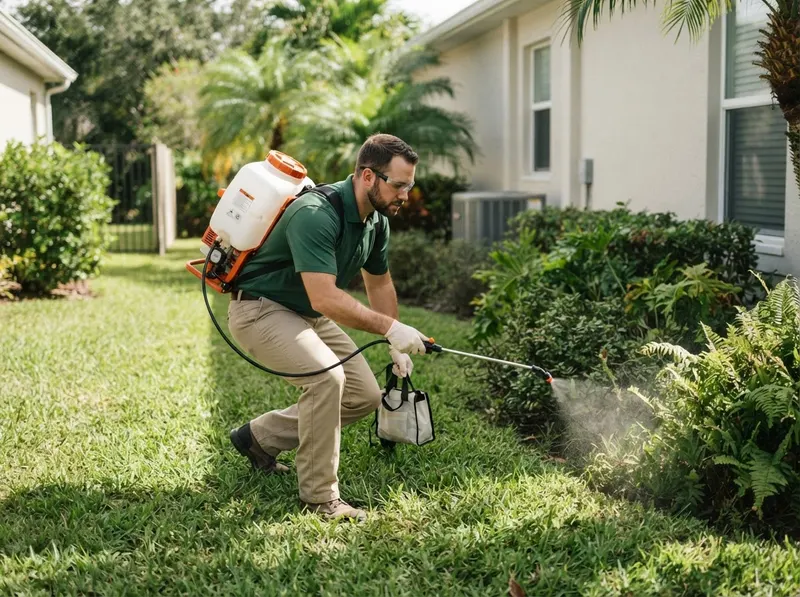
Flea and tick yard management in Fort Myers requires distinct treatment zones because coastal Lee County experiences continuous humidity and warm winters that prevent natural pest diapause. Properties along shaded corridors in Whiskey Creek and older parcels in the Dean Park Historic District often feature mature live oaks, dense leaf debris, and decaying organic mulch where cat fleas (*Ctenocephalides felis*) complete their 21-day life cycles beneath canopy shade. Conversely, master-planned developments like Botanica Lakes, Paseo, and Pelican Preserve feature berms, St. Augustine turf, and decorative rock borders where blacklegged ticks (*Ixodes scapularis*) and brown dog ticks (*Rhipicephalus sanguineus*) harbor along transition edges between turf and irrigation-fed shrub beds.
Decision guidance depends on the current life stage and pest species identified on the grounds. If active adult fleas are jumping on turf, an adulticide paired with an insect growth regulator (IGR) like pyriproxyfen is necessary to disrupt reproductive cycles across shaded resting zones, whereas preventative seasonal barriers fit open yards with minimal brush. Granular applications are water-activated to move down into the thatch layer where eggs and pupae reside, while liquid mist applications coat low-hanging vegetation up to 3 feet from the soil. The structural trade-off between broadleaf turf treatments and deep landscaping treatments is coverage depth versus target retention: heavy downpours along the Caloosahatchee River corridor wash away non-encapsulated sprays, making microencapsulated suspensions necessary for surviving subtropical afternoon rainstorms.
Flea and tick yard management differs technically from general mosquito spraying or interior pest cleanouts. Outdoor yard management treats ground-level substrate, crawlspace perimeters, and run lines where wild carriers such as opossums, raccoons, and feral cats deposit parasites. In communities like Heritage Palms, Edgewood, and McGregor Meadows, adjacent canal banks and wooded easements allow wildlife to continually re-introduce gravid ticks. Treatment schedules require clear intervals: standard liquid and granular residual combinations last between 30 and 60 days outdoors before microbial degradation and UV exposure require a re-application to maintain parasite control across active pet pathways.
Every job gets a firm, written price after a free on-site visit.
Tell us about your flea and tick yard management job in Fort Myers and we'll send a clear, written quote, usually the same day.
 Caloosa Pine Pest Control